Your vehicle survived the flood. Your insurance claim did not!
Every monsoon, countless vehicles across India are damaged by flooded roads, overflowing drains, and basement parking lots filled with water. Most owners believe that if they have comprehensive motor insurance, the claim will be settled without much difficulty.
Unfortunately, that is not always how it works.
Insurance companies do not reject flood claims simply because a vehicle was damaged by water. They reject—or reduce—claims when the evidence, documentation, policy conditions, or circumstances do not support the claim.
Understanding these reasons can help you avoid expensive mistakes and protect your rights as a policyholder.
Flood Damage does not Automatically Mean Claim Approval.
One of the biggest misconceptions among vehicle owners is that flood damage guarantees insurance coverage.
In reality, insurers investigate several questions before approving a claim.
They want to understand!
- How did the water enter the vehicle?
- Was the damage sudden or gradual?
- Was the vehicle parked or being driven?
- Were policy conditions followed?
- Does the damage fall within the policy coverage?
The answers to these questions often decide the outcome of the claim.
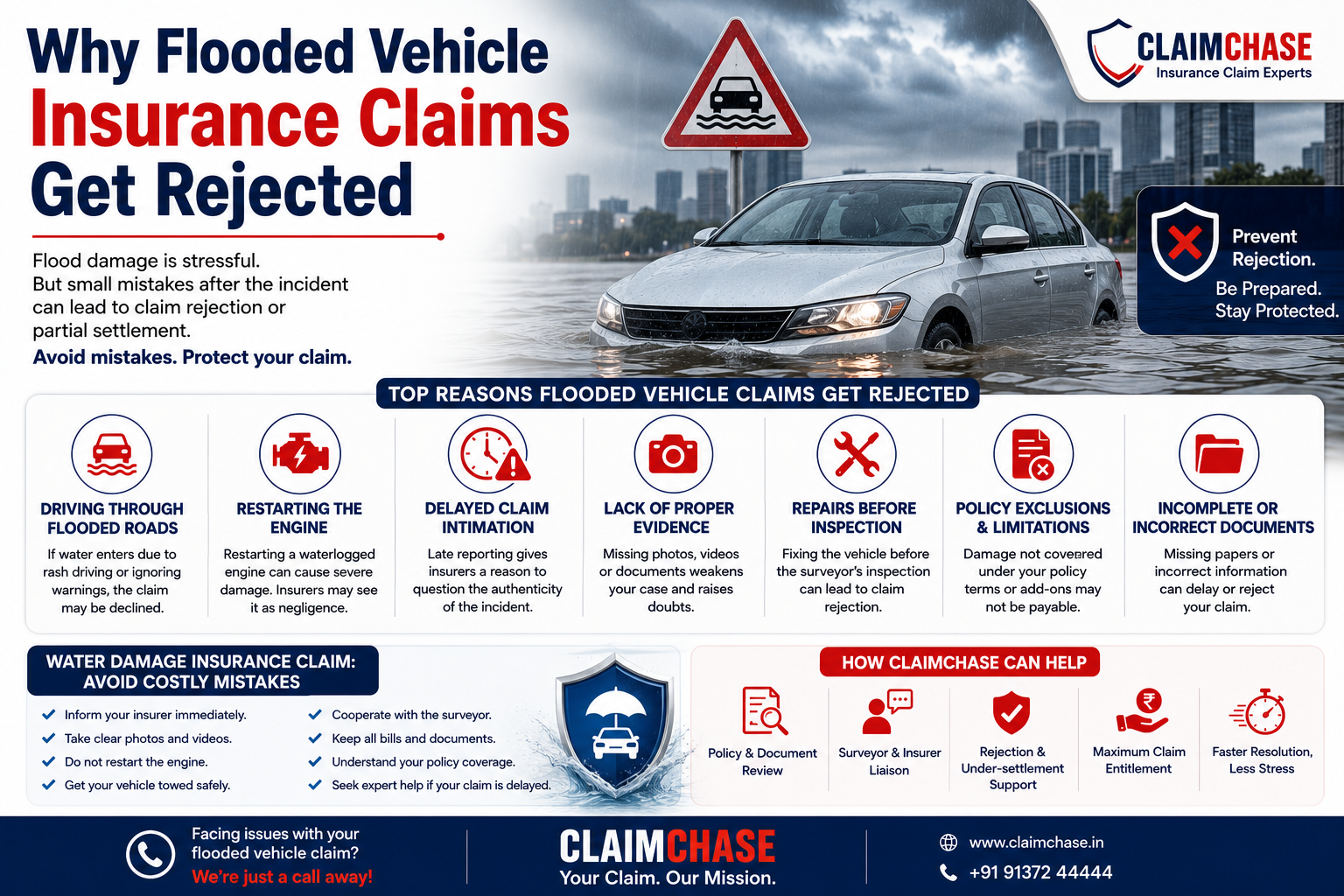
1. Driving Through Flooded Roads.
Many claims become complicated because the vehicle continued moving after entering deep water.
Imagine you are driving home during heavy rain. Water begins rising around your vehicle, but you believe you can make it through.
A few seconds later, the engine stops.
When the surveyor investigates the claim, they may examine whether the damage resulted from unavoidable flooding or from attempting to drive through water that was visibly unsafe.
Every case is assessed individually, but decisions made during those few moments can significantly influence the claim.
2. Restarting a waterlogged engine.
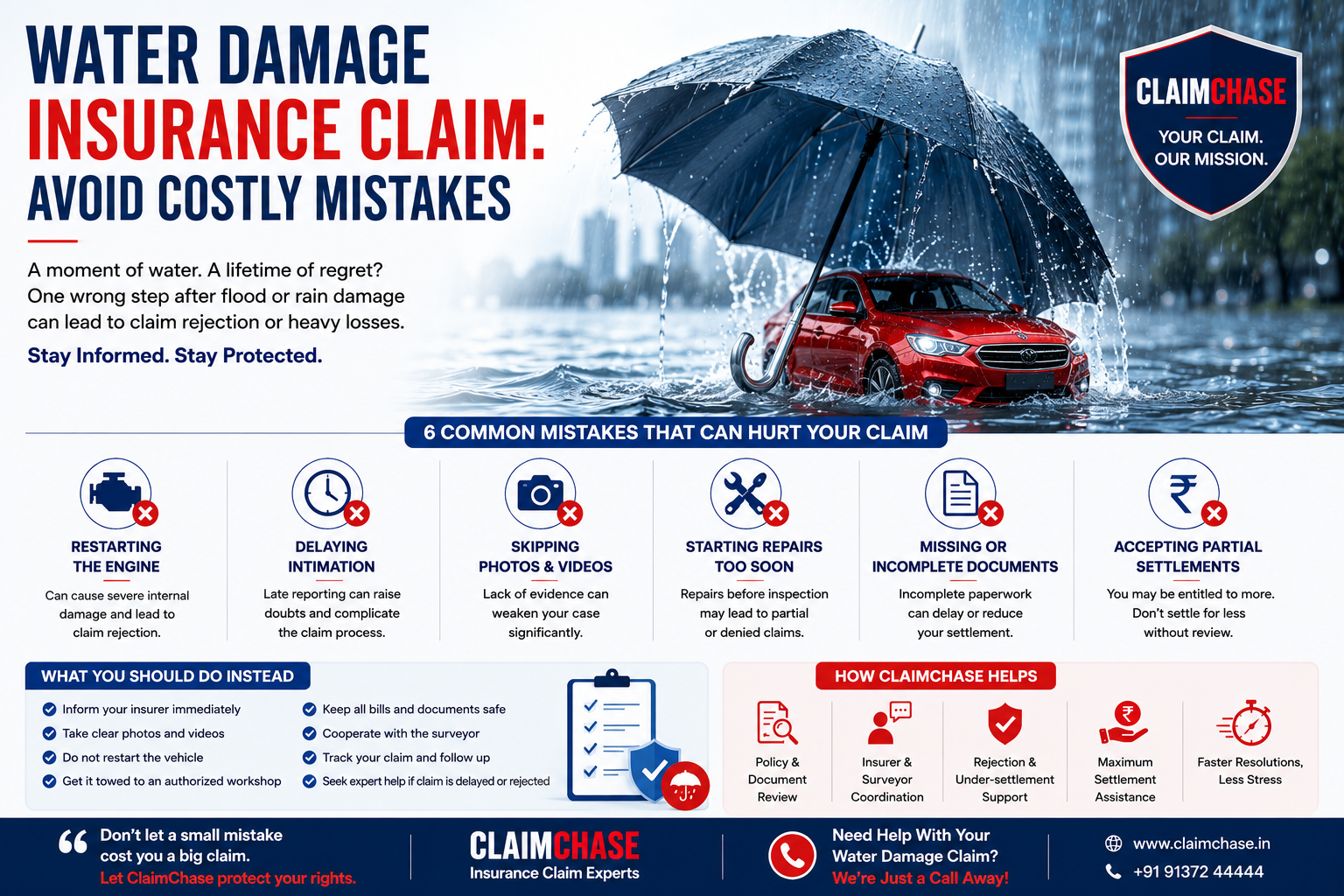
This is one of the most common mistakes after a flood. A stalled vehicle does not always mean catastrophic damage. However, repeatedly trying to restart an engine that has taken in water can cause severe internal mechanical failure. Many owners do not realize that what happens after the flooding may become just as important as the flooding itself.
If your vehicle stalls in floodwater:
- Turn off the ignition.
- Avoid repeated start attempts.
- Arrange towing.
- Inform your insurer.
3. Late Claim Intimation.
Insurance policies generally require policyholders to notify the insurer within a reasonable time after an incident. Waiting several days because you are busy arranging repairs or comparing garages may raise unnecessary questions.
Prompt reporting allows:
- Survey inspection
- Damage assessment
- Photographic documentation
- Faster claim processing
Delays do not automatically result in rejection, but they can complicate the assessment.
4. Missing Evidence!
Insurance decisions rely on evidence—not assumptions. Without proper documentation, even genuine claims can become difficult to evaluate.
Helpful evidence includes:
- Photos of the flooded location;
- Images of the vehicle before towing;
- Videos showing water level;
- Repair estimates;
- Workshop reports;
- Towing receipts;
- Claim acknowledgment
- Communication with the insurer.
The more complete the documentation, the easier it becomes to establish the circumstances of the loss.
5. Repairs Before Inspection!
Wanting your vehicle repaired quickly is understandable.
However, replacing damaged parts before the insurer or surveyor examines the vehicle may make it difficult to determine the original extent of the damage.
Whenever possible, wait for inspection before authorizing major repairs unless immediate work is necessary for safety or further damage prevention.
6. Policy Exclusions That Owners Miss!
Most people read their insurance policy only after something goes wrong.
By then, important conditions may come as a surprise.
Depending on the policy, insurers may review:
- Coverage limitations
- Exclusions
- Waiting periods
- Add-on covers
- Depreciation clauses
- Engine protection benefits, if purchased.
Knowing your policy before accepting repairs or settlement can prevent misunderstandings later.
7. Incomplete or Incorrect Documentation.
Insurance claims involve more paperwork than many people expect. Even small inconsistencies can result in repeated queries.
Common issues include:
- Incorrect claim forms;
- Missing invoices;
- Unclear repair estimates;
- Different damage descriptions;
- Incomplete workshop reports;
- Missing supporting documents;
Well organized documentation often leads to a smoother claim process.
8. Accepting the First Settlement Without Review.
Some policyholders assume the first settlement offered is final.
That is not always the case, Sometimes deductions are based on policy terms,Sometimes, they require clarification, Understanding why certain repair costs were reduced is important before accepting payment. If something does not appear consistent with your policy, it is worth asking questions before closing the claim.
How ClaimChase Supports Vehicle Owners?
- ClaimChase is an independent insurance claim consultancy.
- We do not sell motor insurance policies, nor do we make claim decisions on behalf of insurers.
- Our role is to assist policyholders when claims become difficult to navigate.
Our support includes:
- Reviewing insurance policy wording;
- Examining survey observations;
- Organizing supporting documents;
- Identifying documentation gaps;
- Responding to insurer queries;
- Assisting with delayed claims
- Helping review rejected or undersettled claims
Every claim is reviewed individually because no two flood incidents are exactly alike.
Practical Steps After Flood Damage:
If your vehicle is caught in flooding
- stop driving as soon as it is safe.
- Do not restart a stalled engine.
- Inform your insurer immediately.
- Photograph the vehicle and surrounding area.
- Arrange professional towing.
- Preserve damaged parts where possible.
- Keep every invoice, estimate, and receipt.
- Maintain written communication with the insurer.
Small actions taken during the first few hours often make a significant difference later.
Experience Matters During Complex Claims
Flood damage claims involve more than repair bills.
Survey reports, policy wording, engineering assessments, photographs, workshop documentation, and insurer correspondence all become part of the claim file.
Understanding how these pieces fit together requires experience.
That is where independent claim support becomes valuable—especially when the claim is delayed, questioned, or partially settled.
Final Thoughts:
Floods are unpredictable. Insurance claims should not be.
Most rejected flood damage claims are not the result of a single mistake. Instead, they often involve a combination of delayed reporting, incomplete documentation, misunderstandings about policy terms, or avoidable actions taken immediately after the incident.
Knowing what insurers evaluate—and avoiding common pitfalls—can strengthen your position from the very beginning.
If your flooded vehicle insurance claim has been delayed, rejected, or settled for less than expected, ClaimChase provides independent claim assistance to help .