Avoid Costly Mistakes:
A few inches of water can cause thousands of rupees in damage. The biggest financial loss, however, often comes from avoidable mistakes made after the incident—not the flood itself.
Every monsoon, thousands of vehicles across India are stranded on flooded roads, submerged in parking basements, or damaged by overflowing drains. While most owners immediately think about repairs, very few realize that the first few hours after water damage can determine whether their insurance claim is approved, reduced, or rejected.
At ClaimChase, we have seen a common pattern. Vehicle owners usually make decisions with good intentions, but those decisions can unintentionally weaken their insurance claim.
This guide explains the mistakes to avoid and how expert claim support can protect your interests throughout the claim settlement process.
Understanding Water Damage Insurance Claims
A water damage insurance claim is a request made to your motor insurance company after your vehicle suffers damage due to flooding, heavy rainfall, waterlogging, or similar natural events.
If your vehicle is covered under a comprehensive motor insurance policy, flood related damage may be covered depending on your policy terms, exclusions, and the circumstances surrounding the incident.
The important word here is “may.”
Insurance coverage depends on much more than the presence of water. Insurers assess how the damage occurred, whether policy conditions were followed, and whether sufficient evidence supports the claim.
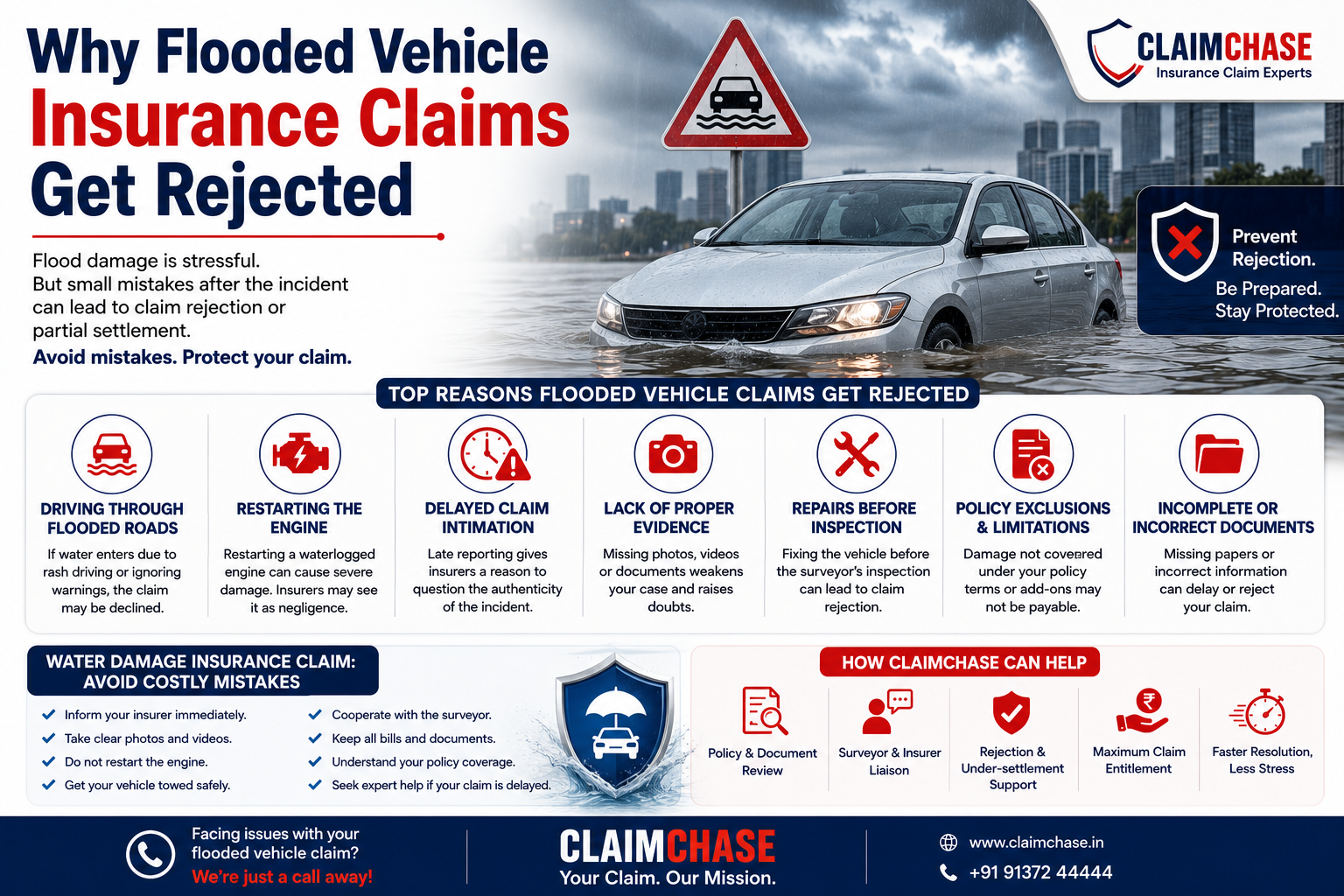
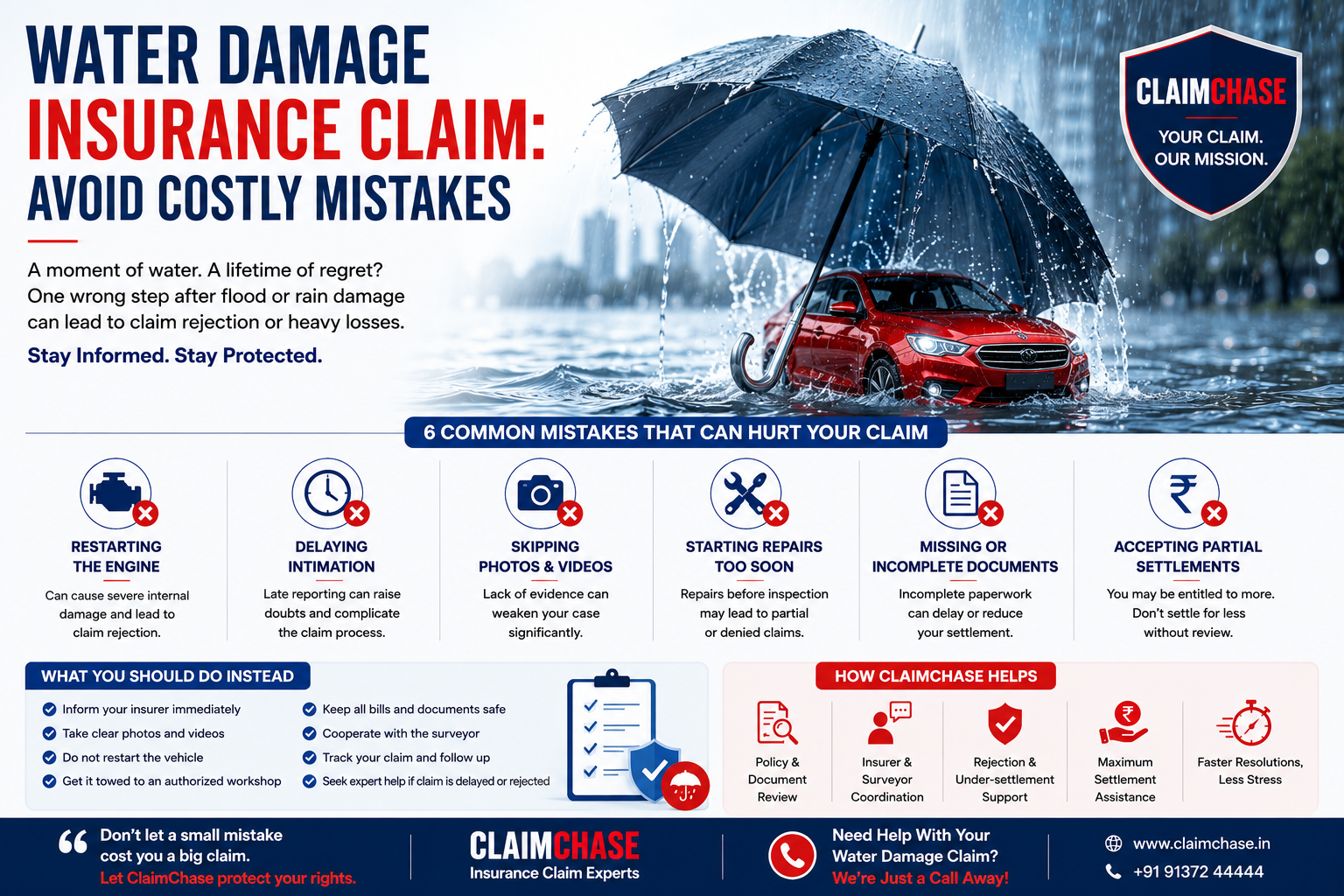
The Most Expensive Mistake: Restarting the engine
Imagine this.
Your car stalls in a flooded street.
The water begins to recede.
A passerby says,
“Try starting it again.”
Many vehicle owners do exactly that.
Unfortunately, restarting a waterlogged engine can significantly increase the damage. If water has entered the engine, attempting to restart it may lead to internal mechanical failure, often referred to as hydrostatic lock.
Depending on the policy and circumstances, this may also complicate the insurance assessment.
Instead:
- Turn off the ignition immediately.
- Arrange professional towing.
- Inform your insurer before repairs begin.
One decision can save both your engine and your insurance claim.
Mistake 2: Delaying Claim Intimation:
Some owners wait until they know the repair cost before contacting the insurer.
Others assume they will report the claim after speaking with their garage.
This delay can create unnecessary questions during claim assessment.
Insurance companies expect policyholders to report an incident as early as reasonably possible.
Prompt notification allows the insurer to arrange inspections, appoint surveyors, and begin documentation before repairs alter the evidence.
Mistake 3: Skipping Photographs.
Most people remember to take photographs after an accident.
Few do the same after flood damage.
Images taken immediately after the incident can become valuable supporting evidence.
Capture:
- Water level around the vehicle
- Exterior damage
- Interior flooding
- Dashboard warning lights
- Engine compartment (where safe)
- Location of the incident.
Short videos can also help establish the circumstances surrounding the loss.
Mistake 4: Beginning Repairs Too Soon
Wanting your vehicle back on the road is understandable.
However, repairing the vehicle before the insurer or surveyor completes the inspection can make it difficult to establish the original extent of the damage.
Unless immediate repairs are necessary for safety, wait for the insurer’s approval before replacing damaged components.
Mistake 5: Losing Important Documents.
Insurance claims rely on documentation.
Missing paperwork often results in repeated queries and delayed settlements.
Keep copies of:
- Insurance policy
- Registration Certificate
- Driving license
- Repair estimates
- Workshop invoices
- Payment receipts
- Towing bills
- Claim acknowledgment
- Communication with the insurer
- Survey reports, where available.
Organized records make the claim process smoother.
Why Some Water Damage Claims Are Only Partially Approved?
Many vehicle owners are surprised when the insurer approves only part of the repair bill.
Partial settlements can happen for several reasons, including:
- Policy exclusions
- Depreciation on certain parts
- Noncovered repairs
- Incomplete documentation
- Differences between workshop estimates and survey findings
- Questions regarding the cause of damage.
Understanding the reason behind deductions is essential before accepting the settlement.
Where ClaimChase Makes a Difference:
ClaimChase is not an insurance company.
We do not issue insurance policies or replace the insurer’s decision-making process. Our role is to help policyholders navigate complex claims with clarity and confidence.
When a water damage claim becomes complicated, we help by:
- Reviewing policy terms.
- Examining claim documents.
- Identifying missing evidence.
- Responding to insurer queries.
- Reviewing settlement calculations.
- Assisting with rejected or undersettled claims.
- Helping policyholders present stronger claim documentation.
Every claim is unique, which is why we evaluate each case individually rather than applying a standard approach.
What Makes Water Damage Claims Different?
Unlike collision claims, water damage often affects hidden components. Electrical systems, sensors, wiring, engine internals, control modules, airbags, and transmission parts may all require inspection before the full extent of damage becomes clear. This is why documentation and technical assessment play such an important role. A claim is not simply about replacing damaged parts. It is about demonstrating how the damage occurred and how it relates to the insured event.
Simple Steps That Strengthen Your Claim If your vehicle has been affected by flooding:
- Stop driving immediately if it is safe to do so.
- Do not restart a stalled engine.
- Inform your insurer without unnecessary delay.
- Photograph the vehicle before moving it.
- Arrange authorized towing.
- Keep every invoice and receipt.
- Save all communication related to the claim.
- Review the settlement carefully before accepting it.
These practical steps can significantly reduce complications later.
Final Thoughts
Flood damage is unpredictable.
The insurance claim process does not have to be. Most claim disputes do not arise because the damage is not genuine they arise because important details are missed, documentation is incomplete, or policy conditions are misunderstood. Being informed from the very beginning gives you a stronger position throughout the claim process.
If your water damage insurance claim has been delayed, partially settled, or rejected, ClaimChase provides independent claim support to help you understand the situation, organize your documentation, and pursue the settlement you are entitled to under your policy. When it comes,to water damage claims, the right decisions made today can prevent expensive consequences tomorrow.