Every monsoon brings the same scenario.
A car comes to a stop in water up to the waist.
A motorcycle fails to start after going through a flooded street.Within hours, the owner stops thinking about the rain and starts wondering if their insurance company will cover the damage.
For many vehicle owners in India, the biggest issue is not the flood itself. It is the confusion that comes after they submit an insurance claim.
At ClaimChase, we support policyholders when insurance claims become complicated.
Whether a claim is delayed, partially approved, or rejected, we help policyholders present their case properly and ensure they get the settlement they are entitled to under their insurance policy.
Why Flood Damage Claims Become Complex?
Floods can cause more than just damage to the outside of a vehicle.
Water can damage the engine, transmission, electrical systems, sensors, wiring, infotainment systems, airbags, and electronic control components.
The problem starts when the insurance company investigates how the damage occurred.
Common questions that often come up include:
- Did the vehicle get driven through a flooded road after the owner noticed the water level?
- Did the engine suffer hydrostatic lock?
- Was the damage caused directly by the flood or by continuing to drive?
- Were repairs started before the insurer completed the inspection?
- Is every damaged part related to the flood incident?
These details often determine whether the claim goes smoothly or faces disputes.
Common Reasons Flooded Vehicle Claims Encounter Problems
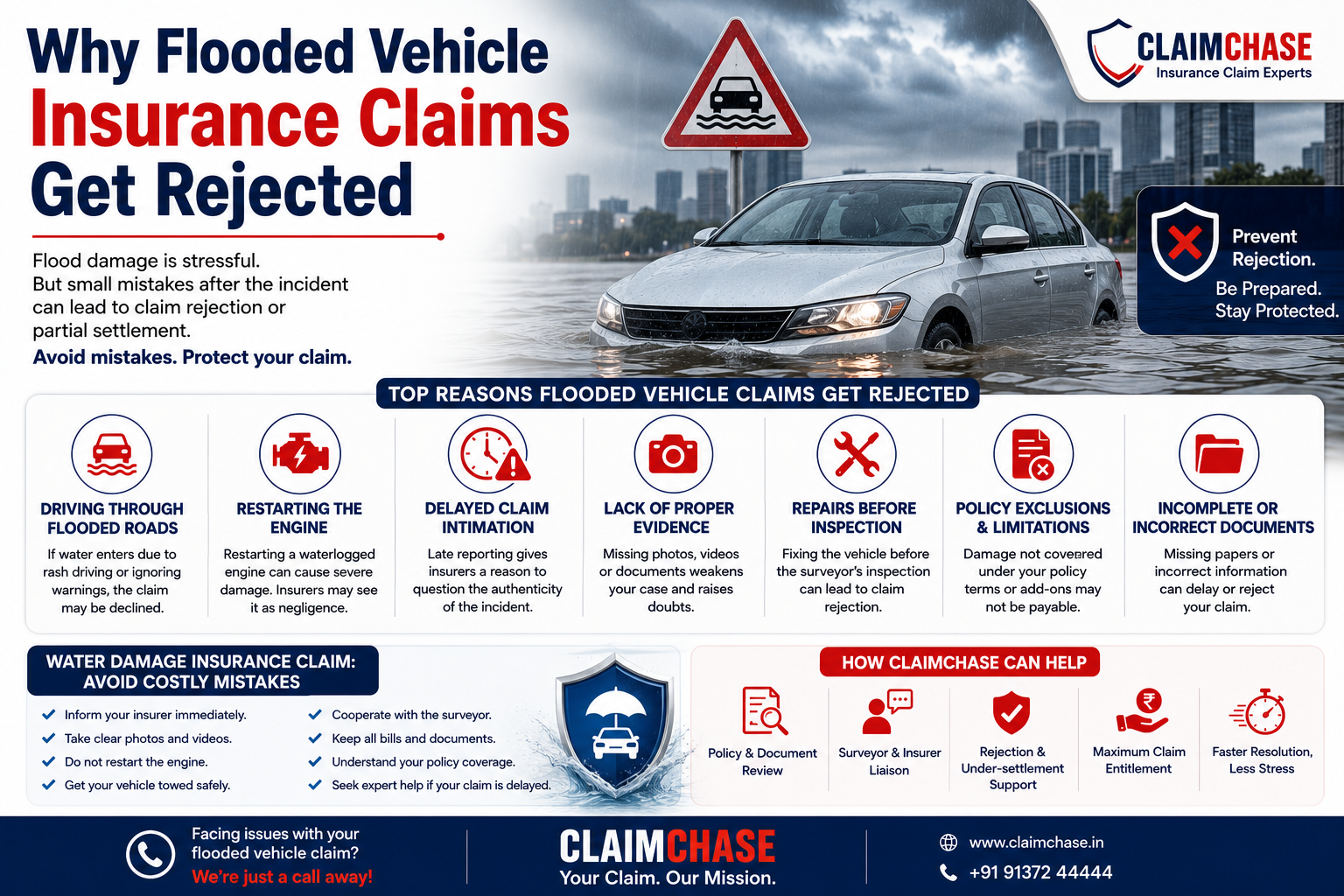
Many policyholders believe that having comprehensive motor insurance automatically means they will be paid after flood damage.
In reality, claims can become difficult due to:
- Missing photographs or videos from the accident scene.
- Delayed claim notification.
- Incomplete repair estimates.
- Poor documentation from the workshop.
- Disagreement over engine damage.
- Policy exclusions.
- Incorrect interpretation of the surveyor’s report.
- Sometimes, the insurer approves only part of the repair cost, leaving the vehicle owner responsible for a large amount.
Where ClaimChase Comes In?
- ClaimChase is not an insurance company and does not sell insurance policies.
- We act on behalf of policyholders.
- Our support begins when you need expert claim assistance—not when you need a new insurance policy.
- Every flood claim is unique, so we avoid generic solutions.
- Instead, we carefully examine the details of your case before recommending the best course of action.
Our Support Includes:
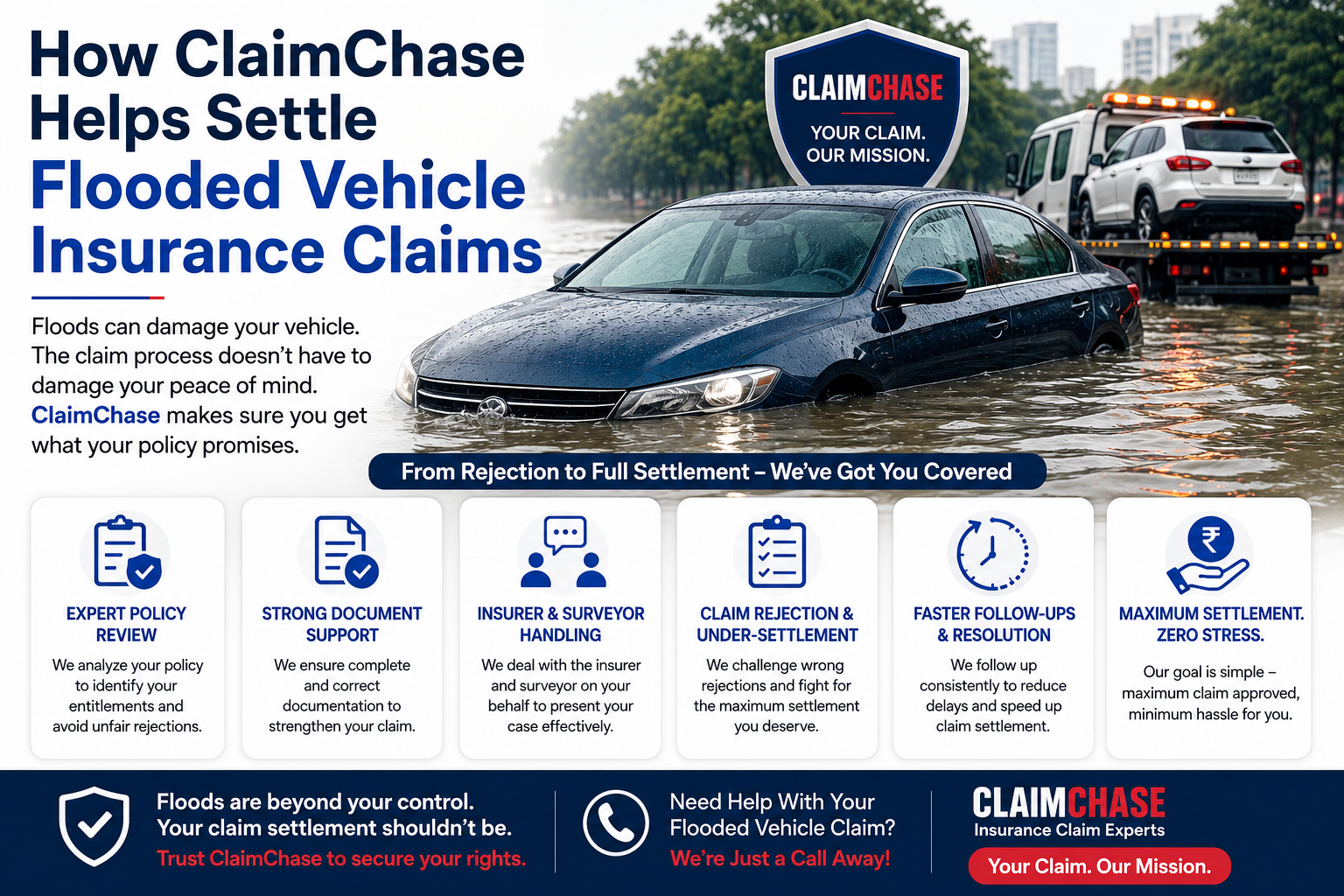
- Reviewing your motor insurance policy.
- Analyzing the surveyor’s report.
- Identifying any missing documentation.
- Organizing repair records and supporting evidence.
- Responding to insurer queries.
- Helping resolve claim disputes.
- Assisting with delayed, rejected, or under-paid claims.
- Our goal is to ensure that your claim is presented clearly, accurately, and in line with the terms of your insurance policy.
- The Difference Between Filing a Claim and Building One
- Filing a claim is just one part of the process.
- Building a strong insurance claim requires evidence that supports the loss.
- For example, insurers often ask for:
- Vehicle registration certificate.
- Driving licence.
- Insurance policy details.
- Repair estimate.
- Survey report.
- Photographs of the damaged vehicle.
- Garage invoice.
- Payment receipts.
- FIR, if applicable.
- Towing receipts.
- Records of communication with the insurer and workshop.
- When these documents are missing or inconsistent, the claim process tends to slow down.
ClaimChase helps organize and present this information in a way that supports the policyholder’s case. If Your Claim Has Been Rejected. A rejection doesn’t always mean the matter is finished.
Many rejected claims involve issues that may need closer examination, such as:
- Misunderstood policy terms.
- Incomplete documentation.
- Incorrect damage assessment.
- Communication problems.
- Settlement calculations that need clarification.
Where appropriate, ClaimChase helps policyholders understand the insurer’s decision and prepares a well-structured response.
Practical Tips After Flood Damage If your vehicle was affected by flooding, taking the right steps immediately can make a big difference.
- Inform your insurer as soon as possible.
- Do not attempt to restart a waterlogged engine.
- Take photos and videos before moving the vehicle.
- Try to preserve damaged parts if possible.
- Keep all invoices and repair estimates.
- Avoid unauthorized repairs before inspection unless it’s necessary for safety.
- Record all communication with the insurer and the workshop.
These simple actions often make the claim process stronger later.
Why Vehicle Owners Choose ClaimChase?
Insurance claims involve technical language, documentation, and follow-up procedures that many vehicle owners face only once or twice in their lives.
ClaimChase handles these situations regularly.
Our team understands how claim documents, policy wording, survey reports, and correspondence with insurers all connect.
This experience lets us spot problems early and help policyholders avoid unnecessary delays.
Instead of going through the process on your own, you get support from professionals who are focused on protecting your interests throughout the claim journey.
Final Thoughts
Flood damage is stressful enough without the uncertainty of an insurance claim.
If your vehicle was damaged due to heavy rains, waterlogging, or flooding, the way your claim is prepared and supported can greatly affect the outcome.
ClaimChase provides independent claim assistance to vehicle owners across India, helping them understand their rights, improve their documentation, and seek fair settlements when challenges arise.