
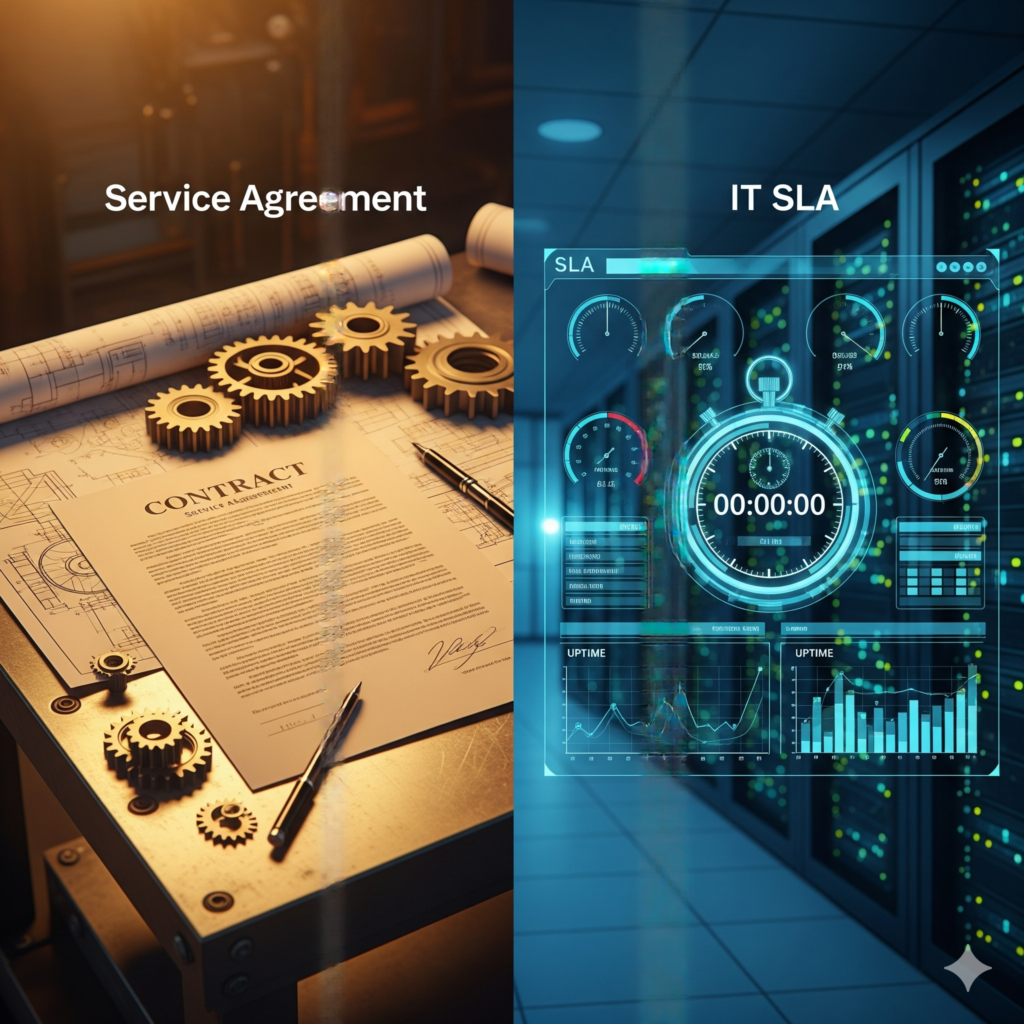
Know the Difference. Avoid Disputes. Protect Your Business.
Many manufacturing and IT companies use the terms Service Agreement and Service Level Agreement (SLA) interchangeably. This misunderstanding often leads to missed expectations, service failures, payment disputes, and legal exposure.
While both documents are critical, they serve very different purposes. Understanding the difference—and using them correctly—can protect your operations, revenue, and long-term relationships.
What Is a Service Agreement?
A Service Agreement is the core legal contract between a service provider and a client. It defines the overall commercial and legal relationship.
What a Service Agreement Covers:
✔ Scope of services
✔ Roles and responsibilities
✔ Commercial terms and pricing
✔ Payment schedules
✔ Intellectual property rights
✔ Confidentiality and data protection
✔ Liability, indemnity, and limitations
✔ Termination and exit clauses
✔ Governing law and dispute resolution
For Manufacturing & IT Companies:
Service Agreements are commonly used for:
- Equipment installation & maintenance
- Software development and implementation
- IT support and managed services
- Industrial operations and outsourcing
- Engineering and technical services
What Is an SLA (Service Level Agreement)?
An SLA is a performance-focused document that defines how well the services must be delivered.
An SLA is often:
- A schedule or annexure to a Service Agreement, or
- A separate document linked to the main contract
What an SLA Covers:
✔ Service availability and uptime
✔ Response and resolution timelines
✔ Quality benchmarks
✔ Maintenance and support levels
✔ Downtime handling
✔ Penalties, credits, or service remedies
✔ Reporting and escalation mechanisms
For Manufacturing & IT Companies:
SLAs are critical where:
- Downtime impacts production
- System availability affects operations
- Support response time is business-critical
Service Agreement vs SLA: Key Differences
| Aspect | Service Agreement | SLA |
|---|---|---|
| Purpose | Defines the legal relationship | Defines service performance |
| Focus | Legal & commercial terms | Operational metrics |
| Scope | Broad and comprehensive | Specific and measurable |
| Enforceability | Primary binding contract | Enforceable through the main agreement |
| Changes | Rarely changed | Updated as service needs evolve |
Why Both Are Essential for Manufacturing & IT Companies
Relying on only one of these documents creates risk.
🚩 A Service Agreement without an SLA lacks performance accountability
🚩 An SLA without a strong Service Agreement lacks legal protection
Together, they:
✅ Set clear expectations
✅ Reduce disputes and blame-shifting
✅ Protect against service failures
✅ Ensure business continuity
✅ Support long-term partnerships
Common Mistakes Companies Make
❌ Treating SLAs as informal documents
❌ Missing penalty or service credit clauses
❌ Vague performance metrics
❌ No escalation or reporting mechanism
❌ Misalignment between the Service Agreement and SLA
These mistakes often surface only when something goes wrong—when it’s already expensive.
How ClaimChase Helps You Get It Right
At ClaimChase, we help manufacturing and IT companies structure, draft, and align Service Agreements and SLAs to work together seamlessly.
Our Services Include:
✔ Drafting and reviewing Service Agreements
✔ Creating measurable, enforceable SLAs
✔ Aligning commercial terms with performance obligations
✔ Risk mitigation and liability protection
✔ Contract restructuring and dispute prevention
Get Contracts That Actually Work for Your Business
Whether you’re a service provider or a client, clarity in contracts protects your time, money, and reputation.
📞 Speak to a contract expert today
📲 Call +91 9373267717